Names and wordplay
Japanese name puns
One name hides a cup of brown-sugar bubble tea; another says there is no money in your pocket. Explore the Chinese-language wordplay behind these handles, then try a few Japanese sound connections.
Look up a Kanji readingName jokes shared online
10 Japanese-looking handles with a hidden joke
These circulating handles tuck Mandarin or Hokkien phrases into Japanese-looking kanji names. Read them in the language shown on each card to hear the joke; 英英美代子 and 宮本美代子 draw on Hokkien.
黑堂真乃
Mandarin wordplayThe hidden phrase黑糖珍奶 — brown-sugar pearl milk tea
What looks like a surname and given name turns into a drink order.
See the source久菜和子
Mandarin wordplayThe hidden phrase韭菜盒子 — a stuffed Chinese chive pocket
A roll call on the page becomes a snack order when spoken.
See the source森上梅友前
Mandarin wordplayThe hidden phrase身上沒有錢 — I have no money on me
An impressive-looking handle gives away the state of its owner’s wallet.
See the source五十嵐太貴
Mandarin wordplayThe hidden phrase五十嵐 + 太貴 — the drink-shop name 50嵐 followed by “too expensive”
This older joke slips a price complaint into the shape of a personal name.
See the source英英美代子
Hokkien wordplayThe hidden phrase閒閒無代誌 — idle, with nothing to do
Even the day’s empty schedule gets tucked into the name.
See the source宮本美代子
Hokkien wordplayThe hidden phrase根本無代誌 — absolutely nothing to do
Pair it with 英英美代子 for a duo with plenty of free time.
See the source梅川內酷
Mandarin wordplayThe hidden phrase沒穿內褲 — not wearing underwear
Similar-sounding characters turn a cheeky phrase into a game handle.
See the source松下褲帶子
Mandarin wordplayThe hidden phrase鬆下褲帶子 — loosen the waistband
松下 looks like a surname until the rest of the phrase catches up.
See the source濱崎霖
Mandarin wordplayThe hidden phrase冰淇淋 — ice cream
Say the three characters briskly and a dessert starts to emerge.
See the source真島梅
Mandarin wordplayThe hidden phrase真倒楣 — what rotten luck
A short handle doubles as a small, self-deprecating sigh.
See the sourceThose handles play on Mandarin or Hokkien. Next, switch to Japanese: Satō and a worked Chinese-name example show how a reading can connect with a familiar word.
Write down the pronunciation first
Characters that look unrelated can lead to the same spoken sequence. Write the reading you plan to use in kana, then look up that whole sequence. For a Chinese name, decide whether you want its Japanese kanji readings or a Katakana approximation of the Chinese pronunciation. Each route gives you different sounds to play with.
Now try two puns in Japanese
The 顧翔 row combines two on-readings for illustration. Use a person’s own reading when referring to their actual name.
| Name or character combination | Kana | Word association | How it works |
|---|---|---|---|
| 佐藤 | さとう / サトウ | 砂糖 (さとう): sugar | The surname and noun share their kana |
| 顾翔 / 顧翔 | コ + ショウ → コショウ | 胡椒 (こしょう): pepper | Two on-readings join into a word |
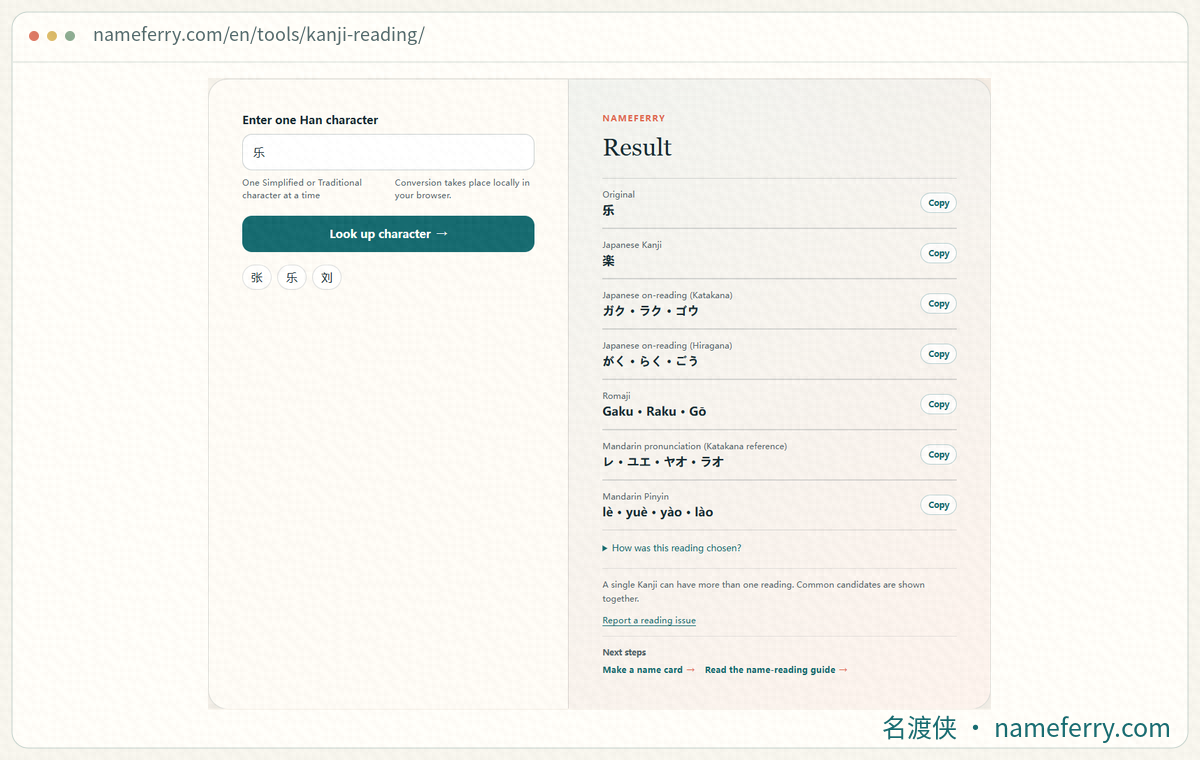
Use NameFerry to check common readings of a character with multiple pronunciations, then return to the name or passage.
Satō and sugar: an introduction people can remember
佐藤 is commonly read さとう. The word 砂糖, meaning sugar, also has the reading さとう. The National Diet Library supplies the surname’s kana in its biographical record for Satō Naotake; Shogakukan’s dictionary supplies the noun. The connection becomes easy to see once both are written in kana.
If your surname is Satō, a casual introduction could include 「砂糖のさとうです」 to give the listener a memory cue. For a handle, you might keep the sound and pair it with a sweets theme you actually like.
顧 + 翔: follow both readings all the way through
顧 has the on-reading コ, and 翔 has ショウ. Together they give コショウ, matching the kana of 胡椒, pepper. This is a useful way to explore a Chinese name: read the entire combination aloud, then check whether it resembles a familiar word.
A single-character lookup gives reading candidates. 翔 can have a different reading in an actual name. Once you choose a pronunciation for your own nickname, show its kana beside the characters so other people can follow it.
Keep the long vowels and small kana
The final う in さとう and こしょう contributes to a long vowel. The spellings Satō and Koshō make that length visible in Romaji. Dropping the length changes the sound you are comparing with the dictionary word.
Check the small kana too. ショウ contains a small ョ; シヨウ gives a different sequence. If a nickname contains ッ, keep its brief consonant pause when you say it. Adding or removing these details just to make a match on screen can lose the spoken connection.
Give a candidate three quick checks
Look up the characters and write the full reading. Search that kana sequence in a Japanese dictionary. Then put it into 「〇〇です」 and say the whole introduction aloud. A combination that looks clever in separate pieces may feel awkward as a name.
Read the dictionary’s examples as well as the definition. They help you see where the word belongs. If someone who knows Japanese can listen, ask what they hear first and whether the name is easy to mishear. That feedback is more useful than adding more speculative puns to a list.
Keep a shortlist with three columns: chosen characters, full kana and word association. Whenever you change the reading, check the full sequence again. A candidate that takes a long explanation might be a better private joke among friends; keep your public handle easy to say.
Give the nickname a suitable home
A game handle, personal profile or nickname among friends gives you room for wordplay. Choose a word you would enjoy being called. When the joke involves someone else’s name, check that they enjoy the association too.
For flight tickets, hotel registration and identity fields, follow the required document spelling and the form’s instructions. Put the playful nickname in a profile, social account or name-card note, where people can use it as you intend.
Sources for the example readings and meanings
Explore the name’s spelling and reading
How do you read a Chinese name in Japanese?
Compare Japanese kanji readings with Chinese-sound Katakana before choosing a pronunciation.
Why Japanese names cannot be read by on’yomi alone
Compare Chinese-name on-readings and learn how Katakana, Hiragana and Romaji differ.
How are common Chinese given-name characters read in Japanese?
Compare Japanese glyphs, on-readings and Mandarin Katakana for common given-name characters.
How to write a Chinese name in Japanese Katakana
Compare Japanese readings, Mandarin pronunciation and the available Kana formats.
Start with one character from your name
Look up its reading candidates, keep the one you want to explore, then listen to the full combination.