English names in Japanese
Your English name in Katakana
Michael becomes マイケル, while Sean commonly becomes ショーン. Start with how the person says the name; the letters alone can be misleading.
Convert my English nameStart with how you say your name. Familiar examples show how that sound becomes Katakana, including long vowels and small characters.
Have the spelling and pronunciation ready
Enter a name such as Michael Smith in the converter to get Katakana, Hiragana and a Roman-letter reading. Use the result as a starting point to check against the person’s pronunciation.
Already use a Katakana spelling at school, work or on a Japanese account? Keeping that spelling makes your name easier to recognise across those settings.
Eight names to compare
These examples match the site’s converter. Louis and Graham have alternative candidates; choose with the person’s pronunciation and established spelling in mind.
| English name | Katakana example | What to check |
|---|---|---|
| Michael | マイケル | Read the whole name together |
| Emma | エマ | The double m gives マ here |
| Alice | アリス | The ending becomes ス |
| Sean | ショーン | Keep the long-vowel mark ー |
| John | ジョン | ョ is a small character |
| Sarah | サラ | Check the person’s established spelling |
| Louis | ルイ / ルイス | Confirm the intended pronunciation |
| Graham | グレアム / グラハム | Choose the closer reading |
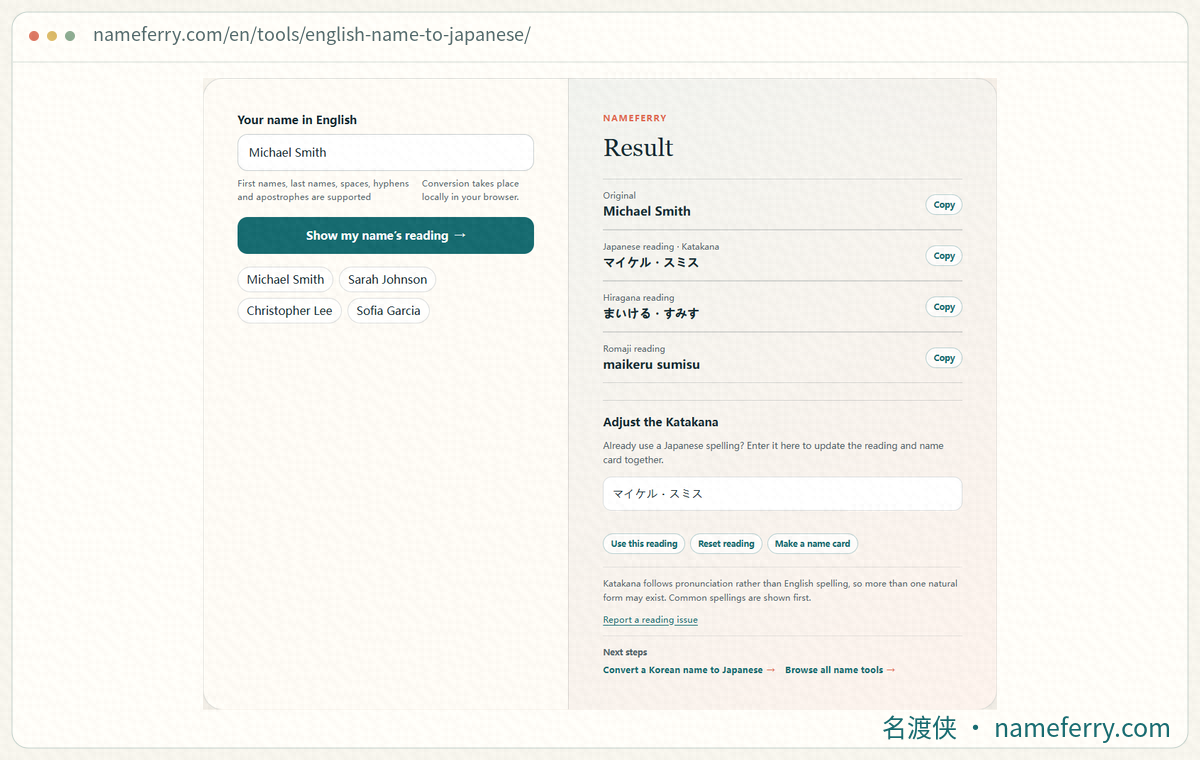
Enter an English name in NameFerry and compare the Katakana with the person’s pronunciation and established spelling.
Why does Sean become ショーン?
Saying the letters of Sean one by one will not get you ショーン. Listen to the name as a whole, then compare its Japanese sound. In John, ジョ is a combination: the ョ is smaller than the surrounding characters.
For an unfamiliar name, the converter may estimate a reading from the spelling. Check that estimate, especially its ending, vowel length and small kana.
One spelling can have several readings
The tool offers ルイ and ルイス for Louis, and グレアム and グラハム for Graham. Choose the form that fits the individual. A person’s existing Katakana signature is a useful reference.
Japan’s official loanword guidance allows for established forms and exceptions for proper names. When preparing someone else’s contact details, asking which spelling they use is a practical shortcut.
Keep long vowels and small kana intact
The ー in ショーン marks a long vowel. The small ョ and the voicing marks in ジョン also affect the reading. Copy them together; a keyboard hyphen - is a different character from ー.
Once the reading is settled, adjust full-width or half-width formatting to the destination form’s instructions.
Putting Michael Smith into separate fields
The converter displays マイケル・スミス with a middle dot between the parts. In separate family-name and given-name fields, Smith is the family name and Michael is the given name. Their readings are スミス and マイケル.
For a combined field, follow its example for spaces or dots. Keep the travel-document spelling in flight-booking fields that request that name in Latin letters; put kana in fields asking for a reading.
Adjust the result before copying
After conversion, use the Katakana editing field beneath the result. Names such as Louis and Graham also show candidate buttons, which update the reading immediately. To use your own spelling, enter it in the field and apply the edit.
Hiragana and Roman-letter readings update with the edit. マイケル gives まいける and maikeru; the English spelling remains Michael. You can also place the checked reading on a name card.
Read the complete name once more
Confirm the name parts and pronunciation, then check long vowels, voicing marks, small kana and separators. For a long name, check each part before reading the full line.
Save the agreed spelling in your contacts or notes so you can reuse it consistently.
Quick questions
Can I get a Japanese name written in kanji?
Katakana represents the sound of your name. A kanji nickname is a separate choice; keep your original spelling wherever identification details are requested.
Why does the Roman-letter result look different?
It spells the Japanese reading: アリス gives arisu. Your English name is still Alice.
Keep the spelling you use
Pronunciation and personal preference can produce different Katakana forms for the same English spelling. Confirm one with the person and keep it handy.
Japanese spelling references
More name and kana guides
How do you read a Chinese name in Japanese?
Compare a Chinese name’s Japanese character forms, kana and readings.
How to fill in Furigana with a Chinese name
Distinguish name, Furigana, Hiragana and Roman-letter fields.
How do you write a Chinese name in Japanese hiragana?
Compare the hiragana and katakana forms of a Chinese name’s Japanese on-reading.
Does the family name or given name come first?
Match family and given names with common Japanese and English field labels.
Try your own English name
Check the reading after conversion and adjust the Katakana if needed.