Japanese romanization · 2025 revision
Japan’s romanization update: which spelling should you use?
The table uses shi, chi and tsu. Long vowels can take a macron or follow the kana spelling with paired vowels. Established forms such as Tokyo and matcha have their own place, too.
Compare a name’s kana and romajiSeeing both si and shi? The spelling system explains the difference. Compare the forms below, then check the separate points about names and passports.
Start with the December 22, 2025 guidance
Japan issued its revised Romanization of Japanese guidance on December 22, 2025. A single main table sets out spellings for contemporary Japanese in general public use. The Agency for Cultural Affairs followed it with a February 2026 Q&A covering names, long vowels and keyboard input.
Choose a spelling for the job in front of you: pronunciation notes, an established place name, or a name field on a form. The comparison below brings together the guidance and other spellings you may encounter.
Eight spelling checks
The guidance column follows the main table and supplementary rules. The next column shows older or established alternatives.
| Kana or word | Guidance spelling | Also encountered | What to check |
|---|---|---|---|
| し | shi | si | The main table uses shi |
| ち | chi | ti | The main table uses chi |
| つ | tsu | tu | The main table uses tsu |
| ふ / じ | fu / ji | hu / zi | Both pairs appear in the comparison table |
| かんぱい / しんばし | kanpai / Shinbashi | kampai / Shimbashi | The guidance uses n; quote station names as displayed |
| まっちゃ | maccha | matcha | Double the c in ch; keep a product’s established name |
| とうほく | Tōhoku / Touhoku | Tohoku | Keep the long vowel in pronunciation notes |
| とうきょう | Tōkyō / Toukyou | Tokyo | Quote the spelling used by the named place |
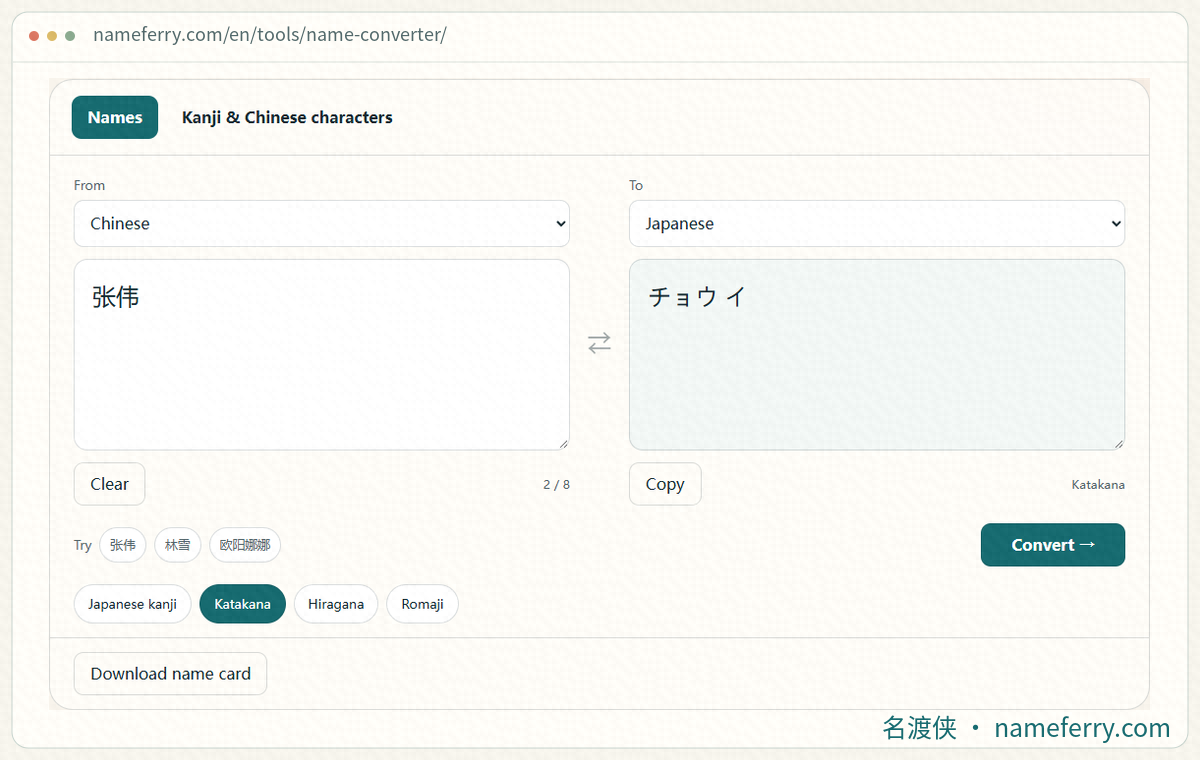
Enter a Chinese name in NameFerry to compare character forms, kana and Romaji. Replace the sample with your own name.
shi, chi, tsu—and n for ン
The main table uses shi, chi, tsu, fu and ji. When an older text gives si, ti, tu, hu or zi, the attached comparison table helps you connect them to the same readings. Keeping one scheme in your own notes makes words easier to find again.
For ン, the guidance consistently uses n: kanpai and Shinbashi are examples. Some stations and established names use m in these positions. Copy the operator’s displayed spelling when looking up a station or quoting its name.
How まっちゃ becomes maccha
Small っ marks a consonant hold. The guidance represents it by doubling the following consonant; for a two-letter consonant, repeat its first letter. In maccha, ch supplies the extra c. In zasshi, sh supplies the extra s.
Matcha is also an established international spelling and appears in the guidance’s discussion of existing usage. Use maccha to practise the stated rule. When quoting a drink, shop or product name, keep the spelling that name actually uses.
Long vowels: Tōhoku and Touhoku
The line above ō is a macron marking vowel length. The guidance also allows vowel letters to follow modern kana spelling: とうほく becomes Touhoku, while おおの can become Oono. One keeps ou and the other oo, matching their kana.
These forms preserve useful distinctions: おの and おおの, or ゆき and ゆうき. In reading notes, Ōno / Oono and Yūki / Yuuki show the extra length. When referring to a person, use that person’s chosen spelling.
For words such as しいたけ and へいせい, shiitake and Heisei are customary. Check the original kana when deciding how to write a long vowel, and keep the kana beside your romaji while proofreading.
Keep established names such as Tokyo
The guidance recognises established forms such as Tokyo and judo, and asks writers to respect the choices of people and organisations when spelling their names. Check a person’s signature, an organisation’s website or an official map before quoting a name.
For a pronunciation note, とうきょう can be written Tōkyō or Toukyou. An existing address or English place name using Tokyo keeps that spelling. For passports, airline bookings and registered records, check the travel document and the receiving service’s requirements, then use the recorded name.
Keep using your usual Japanese input method
Keyboard input continues as before. Question 52 of the official Q&A says the revision has no effect on input methods. Your input method can still use sequences such as di, du and wo to produce ぢ, づ and を.
When writing their pronunciation in romaji, the particles は, へ and を appear as wa, e and o. When typing the kana, follow your input method’s keys. Keeping a pronunciation line and a keystroke line in your notes makes the two tasks easy to practise.
Check the purpose before you save or submit
For study notes, check the kana first, then the main-table spelling, n, doubled consonants and long vowels. Keep your treatment of long vowels consistent within the same set of notes.
For quoted names, keep the spelling confirmed by the person or organisation. For a form or booking, identify whether the field wants the name in Latin letters, a Japanese reading or Katakana. A name tool can help compare kana and romaji; check the original record character by character before submitting.
Common questions
When was the new guidance issued?
It was issued on December 22, 2025. The Agency for Cultural Affairs published a further Q&A in February 2026. This guide uses those two official documents.
I have always written my name Ohno. Should I change it to Oono?
Keep the spelling you use or have registered for your name. The guidance allows Ōno or Oono to show the reading and asks writers to respect individual name choices. For identity documents and bookings, check the relevant document and service rules.
Can I write Touhoku if typing ō is awkward?
Yes. The guidance allows paired vowel letters following modern kana spelling, so とうほく can be written Touhoku. An established place name or registered personal name keeps its confirmed spelling.
Keep a copy of the original name
Save the kana alongside the romaji used by your source. You can practise the reading and still search for the same person or place later.
Official references
More on readings and name spellings
How do you read a Chinese name in Japanese?
Compare Japanese forms, kana and readings of Chinese names.
What is the difference between Japanese romaji and Pinyin for a Chinese name?
See how a Japanese on-reading becomes romaji and how it differs from Hanyu Pinyin.
Does the family name or given name come first?
Match family and given names with common Japanese and English field labels.
Your English name in Katakana
Compare English-name examples, alternate readings and Japanese form fields.
Type Japanese on a computer or phone
Set up Japanese input and practise ん, small letters, conversion and phone flick input.
Check a name with its kana beside it
Compare the kana and romaji, then use the spelling suited to your document or reading notes.