Reading Japanese passages
Add furigana to a Japanese passage
Paste Japanese text into the passage tool and press Add furigana. Hiragana appears above words containing kanji, so you can follow the original sentence as you read.
Add furigana to my textSometimes a few unread kanji interrupt the whole sentence. Furigana above those characters helps you keep the original text in view and spot the words worth checking.
Paste a paragraph, then press Add furigana
Open the text-reading tool, paste Japanese into the input box and press Add furigana. The result keeps the original kanji and kana, with hiragana above words containing kanji. On a phone, the input and result appear one after the other.
Each conversion accepts up to 1,000 characters. Start with a complete paragraph from a message, lesson or article. Keep its punctuation and line breaks, then move on to the next paragraph. Editing the input leaves you time to finish; press the button again to update the result.
What to look for in the examples
These words come from the two sentences below. Readings attach to word segments; a verb segment may include its following kana.
| Original segment | Reading above it | Reading cue |
|---|---|---|
| 来週 | らいしゅう | Next week; read the whole word |
| 友達 | ともだち | Friend; keep the word together |
| 京都 | きょうと | Small ょ combines with き; う extends the vowel |
| 行き | いき | Continue into ます to read いきます |
| 図書館 | としょかん | Library; ょ is small |
| 日本語 | にほんご | The Japanese language |
| 本 | ほん | A book in this sentence |
| 読み | よみ | Continue into ます to read よみます |
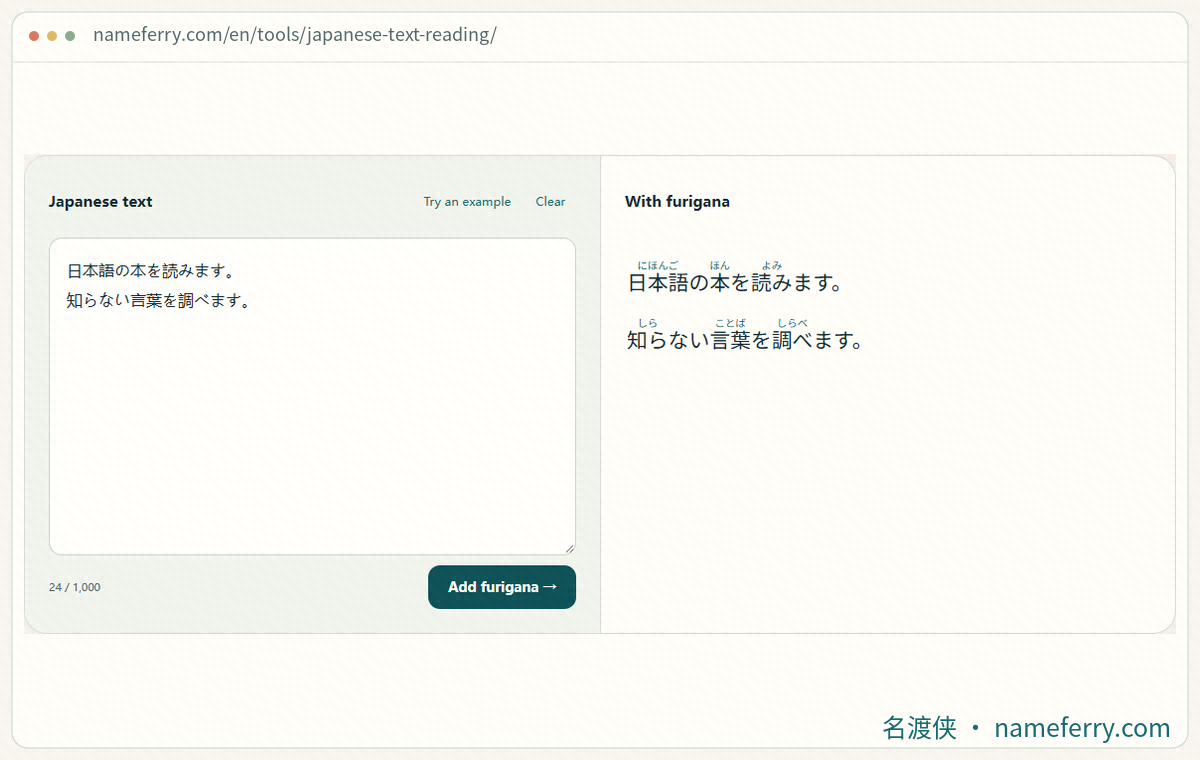
Paste Japanese text into NameFerry and add furigana to read the kana above the original kanji.
Two sentences with the tool’s actual readings
Copy either original sentence into the tool to try it. The readings below match its current output.
来週、友達と京都へ行きます。
来週、友達と京都へ行きます。
図書館で日本語の本を読みます。
図書館で日本語の本を読みます。
Follow a word, then return to the sentence
Read ともだち above 友達 as a whole word. In 京都, きょ is one combined sound and the following う lengthens its vowel. Recognizing the characters gives you a useful clue; learning the Japanese word supplies its reading.
Use a kana chart for unfamiliar symbols. Keep small ょ, ゅ and ゃ with the kana before them, give long vowels their full length, then read the word in its sentence again.
Why 行き has いき above it
The tool annotates 行き as いき and leaves ます after that segment. Read the complete verb as いきます. Likewise, 読み has よみ above it, followed by ます. The upper reading corresponds to the entire segment below it.
Kana following a verb’s kanji are called okurigana and help show its inflection. To look up 読みます in a dictionary, use the dictionary form 読む(よむ). Keep the original ます form when reading this sentence aloud.
Check dates and proper names separately
一日 is read ついたち when it means the first day of a month. For a duration of one day, いちにち is common. Automatic readings can miss these distinctions. With a date, first establish whether the sentence names a calendar day or describes a length of time.
For personal names, look for the person’s own spelling or introduction. For stations and place names, check the operator’s kana label. The Kanjipedia entry linked below records 一日(ついたち). Check these words before using a passage for a presentation or class.
Keep punctuation and split at sentence boundaries
Paste one complete paragraph and finish at a full stop where possible. Read it before moving to the next part. Cutting a sentence in half near the character limit makes its meaning harder to follow.
The output preserves Japanese commas, full stops and line breaks. Remove unrelated menus, buttons or captions copied from a webpage. For an image or screenshot, obtain and check a text version before pasting it into the tool.
Try the original once more
Read a sentence with the furigana, then try following only the original text. Keep difficult words with a short phrase around them: 図書館で is a useful reminder of where 図書館 fits in the sentence.
English meanings accompany the two examples on this page. The tool itself displays the original and its readings; use a vocabulary or grammar reference when you also need help with meaning. Your own writing, material you have permission to use and public-domain texts are suitable practice sources.
Practical questions
Does every keystroke start a conversion?
Finish typing or pasting, then press Add furigana. After an edit, press it again to update the result.
Why do some kana have no reading above them?
Hiragana and katakana are already phonetic. The tool adds readings mainly to words containing kanji, leaving original kana such as と, へ and ます in place.
Can I paste a screenshot?
The current input accepts text. Extract the Japanese writing from the image, check the characters and paste the text before converting.
Check uncertain words before reading aloud
Dates, personal names and unfamiliar place names deserve a separate check. Once they are settled, read the complete sentence again.
Reading and ruby-format references
More kana and kanji help
How do you read a Chinese name in Japanese?
Compare Chinese names with Japanese character forms, kana and romanization.
How do you write a Chinese name in Japanese hiragana?
Compare the hiragana and katakana forms of a Chinese name’s Japanese on-reading.
How to fill in Furigana with a Chinese name
Distinguish name, Furigana, Hiragana and Roman-letter fields.
Katakana name rejected?
Troubleshoot rejected kana by checking width, separators, pasted text and length.
Type Japanese on a computer or phone
Set up Japanese input and practise ん, small letters, conversion and phone flick input.
How to add furigana to Japanese in a screenshot
Extract Japanese from an image, fix order and duplicated ruby, then add furigana.
Furigana changed after pasting? Choose what to keep
Compare base text, parenthesized readings and ruby for Word, Google Docs and print workflows.
Try a short passage
Keep the punctuation and line breaks, convert the text and read a complete sentence.